

If this story resonates with you, please share it with others who will appreciate it too.
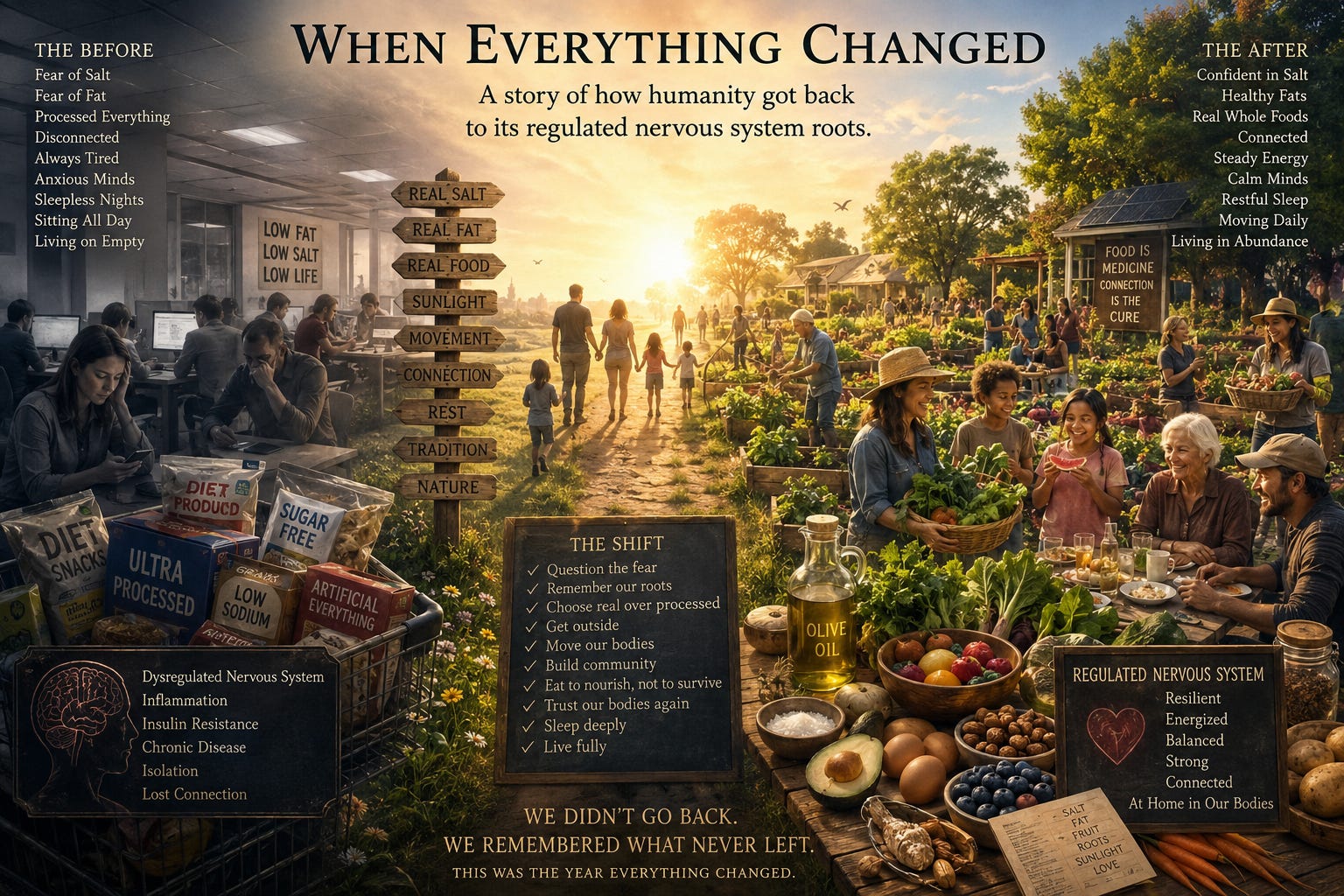
People often ask when everything changed.
Some think it was a groundbreaking scientific paper. Others point to a government policy, a documentary, or a famous doctor changing their mind in public.
But those of us who lived through it remember something much quieter.
It began when people admitted they were tired.
Not the dramatic kind of tired. The ordinary kind. The kind that had become so common no one questioned it anymore.
The afternoon crashes. The constant cravings. The restless sleep. The anxiety that seemed to hover just beneath everyday life. The feeling that every meal required a calculator instead of common sense.
For years, people had tried harder.
They counted calories. They feared butter. They apologized for adding salt. They ate foods with health claims printed in giant letters while the ingredient list read like a chemistry experiment.
Yet somehow, despite all the effort, many people felt less energetic than their grandparents had.
Nobody noticed at first because everyone felt that way.
Then something unexpected happened.
Instead of asking, "What food should we remove?" people began asking, "What has quietly disappeared?"
That question changed everything.
At first, the answers seemed almost too simple.
Real salt.
Natural fats.
Fruit that actually tasted like fruit.
Vegetables grown in healthy soil.
Time outside.
Walking after meals.
Seeing the sunrise.
Talking to neighbors.
Preparing meals instead of merely assembling products.
People laughed.
"It can't be that simple."
Of course they laughed.
The curse of knowledge had become the curse of complexity.
Experts had learned so much that many forgot what health looked like before it became an equation.
Children, however, had no such problem.
Give them strawberries warmed by the sun.
Fresh peaches.
Potatoes roasted with olive oil.
Eggs cooked in butter.
A watermelon shared with friends.
They didn't ask whether the meal fit this year's nutrition trend.
They simply ate.
The first communities to change weren't trying to start a revolution.
They simply started gardens.
One neighborhood replaced a decorative lawn with fruit trees.
Another converted an empty parking lot into raised beds.
Schools planted tomatoes instead of another ornamental hedge.
Retirement communities began growing herbs together.
Something surprising happened.
People stayed outside longer.
Neighbors who had never spoken began exchanging recipes.
Children learned where carrots came from instead of assuming they appeared in plastic bags.
People discovered that food wasn't just fuel.
It was culture.
It was conversation.
It was belonging.
Doctors noticed something curious.
Patients weren't only reporting fewer afternoon crashes.
Many slept more deeply.
Some found themselves waking with more energy.
Others realized they no longer felt driven to snack every hour.
People began spending mornings outside before work.
Lunch breaks became short walks instead of scrolling on a phone.
Families ate dinner together more often.
Stress didn't disappear.
Life was still life.
But many people noticed they felt steadier.
More resilient.
Their nervous systems seemed to remember something ancient:
That sunlight in the morning matters.
That movement throughout the day matters.
That relationships matter.
That food is more than numbers on a label.
There were still debates.
Some people preferred more carbohydrates.
Others preferred fewer.
Some loved dairy.
Others didn't tolerate it well.
The arguments became less about proving one perfect diet and more about learning what helped different people thrive.
One principle quietly united everyone:
Eat food that still resembles where it came from.
The closer a meal looked to nature, the easier it became to understand.
Nobody needed a marketing department to explain an orange.
The biggest surprise wasn't physical.
It was emotional.
People became less afraid.
They stopped fearing birthday dinners.
Stopped fearing butter on vegetables.
Stopped fearing potatoes.
Stopped fearing salt without considering the context of the whole meal and the person's needs.
They learned that nutrition wasn't about finding a villain.
It was about restoring balance.
Meals became something shared rather than optimized.
Grandparents began teaching recipes again.
Children learned family traditions instead of food rules.
The dinner table slowly became a place of connection instead of correction.
Years later, historians looked back at the early twenty-first century with curiosity.
"What made them so confused?" students would ask.
Their teachers smiled.
"They weren't foolish."
"They simply inherited a world overflowing with information but starving for wisdom."
"They measured nutrients but forgot meals."
"They tracked calories but forgot community."
"They optimized productivity but forgot recovery."
"They built lives indoors while their biology still expected the rhythms of daylight."
"They became experts at extending life, but were still learning how to nourish it."
Today, when someone harvests tomatoes from their backyard...
When children pick oranges together...
When neighbors trade herbs over the fence...
When families cook a meal with colorful vegetables, fruit, healthy fats, and food seasoned to taste...
Nobody calls it revolutionary.
Nobody posts about it.
Nobody argues online about it.
It's simply called dinner.
And perhaps that's the greatest sign of all.
Health finally became ordinary again.
Not because everyone agreed on every detail.
But because society remembered something our ancestors, grandparents, and even our own bodies had been trying to tell us all along:
The human body was never asking us to chase perfection.
It was asking us to come home.
Home to real food.
Home to sunlight.
Home to movement.
Home to one another.
And somewhere along the way, we discovered that coming home wasn't about going backward.
It was about carrying the best of modern knowledge with us while remembering the timeless wisdom we almost forgot.